
FEJA ISLAME · BEGINNERS
Wudu and prayer step by step
A simple introduction to ablution and daily prayer according to the widely practised Sunni Hanafi tradition, as found in many communities in Kosovo and Turkey.
Note: This page is a beginner learning aid and follows basic Hanafi practice. For illness, travel or special personal situations, ask a qualified local imam or mosque.
1 · WUDU
How to perform ablution
These steps show the usual complete sequence. In Hanafi teaching, intention is Sunnah while four basic acts are obligatory.
Before washing: intention
Intend in your heart to make wudu for prayer and begin with “Bismillah”.
 1Hands
Wash both hands to the wrists three times, beginning with the right.
 2Mouth
Rinse the mouth thoroughly three times.
 3Nose
3Nose
Gently take water into the nose and clean it three times.
 4Face
4Face
Wash the entire face three times, from hairline to chin and from ear to ear.
 5Right arm
Wash the right arm up to and including the elbow three times.
 6Left arm
Wash the left arm up to and including the elbow three times.
 7Head / Masah
Wipe once over the upper head or hair area with wet hands. In Hanafi practice, wiping at least one quarter of the head is sufficient.
 8Ears
8Ears
Wipe the ears with moist fingers.
 9Feet
9Feet
Wash the right foot, then the left, including the ankles three times and between the toes.
The 4 fard acts of wudu in Hanafi practice
- Wash the face
- Wash both arms including the elbows
- Wipe over at least one quarter of the head
- Wash both feet including the ankles
2 · PREPARATION
Before prayer
✓ The prayer time has begun.
✓ Wudu is valid.
✓ Body, clothing and place of prayer are clean.
✓ The required parts of the body are covered.
✓ You face the Qibla.
✓ You know which prayer and how many rakats you are praying.
3 · SALAH
Two rakats step by step
Learning two rakats teaches the basic sequence used in three- and four-rakat prayers as well.
 1Intention
Intend in your heart which prayer you are about to perform.
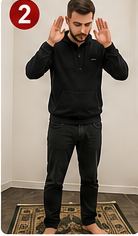 2Opening takbir
Stand facing Qibla, raise the hands and say “Allahu Akbar”, then fold the hands.
 3Qiyam
Recite Subhanaka, then al-Fatiha and a short surah or verses from the Quran.
 4Ruku
4Ruku
Bow with “Allahu Akbar” and commonly say “Subhana Rabbiyal Adhim” three times.
 5Rise
5Rise
Rise saying “SamiAllahu liman hamidah”, then “Rabbana lakal hamd”.
 6First sujud
Go into prostration and commonly say “Subhana Rabbiyal A’la” three times.
 7Brief sitting
Sit calmly between the two prostrations.
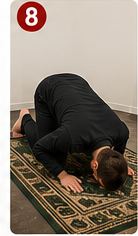 8Second sujud
Prostrate again, then stand for the second rakat.
 9Second rakat
Recite al-Fatiha and a short surah, then repeat ruku, rising and two sujud.
 10Final sitting
Recite at-Tahiyyat, salawat and a concluding dua.
 11Salam
Turn the head right and then left, saying “Assalamu alaikum wa rahmatullah”.
For 3 or 4 rakats
After the second rakat sit for at-Tahiyyat. In a four-rakat fard prayer, Hanafi practice generally recites al-Fatiha in the third and fourth rakats, followed by the usual movements. In the final sitting recite at-Tahiyyat, salawat and dua, then finish with salam.
4 · RAKAT OVERVIEW
The five daily prayers
| Prayer | Before | Fard | After |
|---|---|---|---|
| Fajr | 2 Sunnah muakkadah | 2 | – |
| Dhuhr | 4 Sunnah muakkadah | 4 | 2 Sunnah muakkadah |
| Asr | 4 Sunnah ghayr muakkadah | 4 | – |
| Maghrib | – | 3 | 2 Sunnah muakkadah |
| Isha | 4 Sunnah ghayr muakkadah | 4 | 2 Sunnah muakkadah + 3 Witr |
Fard: obligatory prayer.
Sunnah muakkadah: regularly and strongly emphasised Sunnah.
Sunnah ghayr muakkadah: recommended Sunnah, less strongly emphasised.
Witr: in Hanafi teaching 3 rakats and wajib, prayed after Isha.
5 · LEARN THE TEXTS
Important texts for beginners
Learn slowly and accurately. Transliteration is only a learning aid; correct pronunciation is best learned from a knowledgeable person or at the mosque.
Subhanaka
Transliteration: Subhanaka Allahumma wa bihamdika wa tabarakasmuka wa ta’ala jadduka wa la ilaha ghairuk.
Al-Fatiha
Transliteration: Bismillahir-Rahmanir-Rahim. Alhamdu lillahi Rabbil-alamin. Ar-Rahmanir-Rahim. Maliki yawmid-din. Iyyaka na’budu wa iyyaka nasta’in. Ihdinas-siratal-mustaqim. Siratal-ladhina an’amta alayhim, ghayril-maghdubi alayhim wa lad-dallin. Amin.
Short surah – Al-Ikhlas
Transliteration: Qul huwallahu ahad. Allahus-samad. Lam yalid wa lam yulad. Wa lam yakun lahu kufuwan ahad.
At-Tahiyyat
Transliteration: At-tahiyyatu lillahi was-salawatu wat-tayyibat. Assalamu alaika ayyuhan-nabiyyu wa rahmatullahi wa barakatuh. Assalamu alaina wa ala ibadillahis-salihin. Ashhadu an la ilaha illallah wa ashhadu anna Muhammadan abduhu wa rasuluh.
Salawat
Learn Allahumma salli and Allahumma barik after at-Tahiyyat in the final sitting.
Rabbana atina
Transliteration: Rabbana atina fid-dunya hasanatan wa fil-akhirati hasanatan wa qina adhab an-nar.
Witr and Qunut
In Hanafi practice Witr has three rakats. In the third rakat, after al-Fatiha and a surah, an additional takbir is made and Qunut is recited before ruku. Beginners should learn the exact wording and practice from a qualified teacher.
6 · FOR BEGINNERS
Avoid common mistakes
✓ Do not rush the movements.
✓ Do not leave required areas dry in wudu.
✓ Check prayer time and Qibla first.
✓ Do not confuse fard, Sunnah and Witr.
✓ Improve pronunciation gradually.
✓ When unsure, have the prayer shown to you correctly.
YOUR START PLAN
Learn without being overwhelmed
- First learn wudu confidently.
- Then learn the movement sequence of two rakats.
- Practise al-Fatiha and one short surah.
- Learn at-Tahiyyat and salawat.
- Then practise three- and four-rakat prayers.
- Finally deepen Witr/Qunut and additional Sunnah prayers.